Book Seven Is Here: The Ancient Orchestra of Madaktu
What did music sound like 2,600 years ago? The seventh Tiny Time Traveler book takes Aryan and Ariana to ancient Madaktu, where twenty-six musicians are preparing for a royal procession.
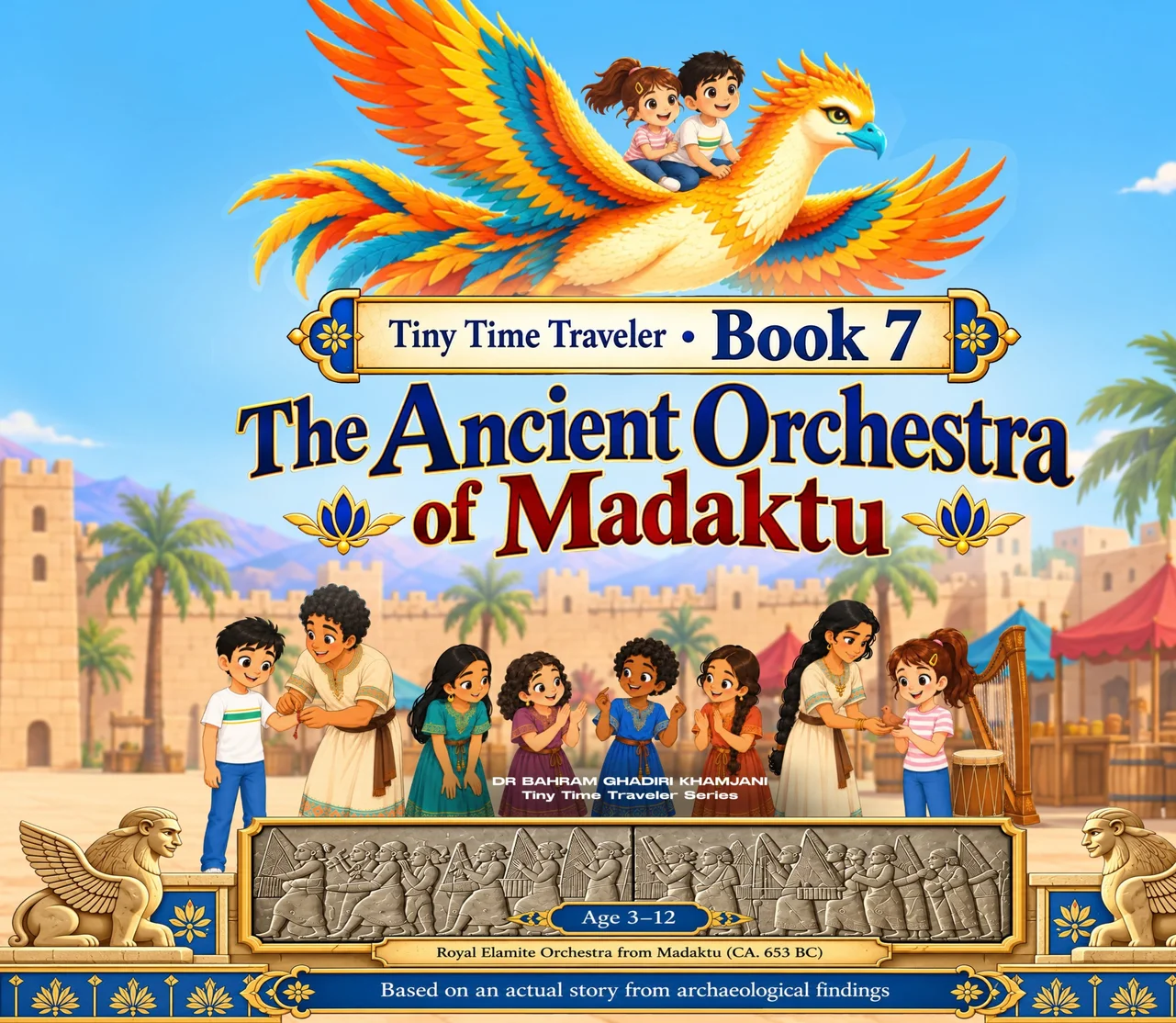
The seventh book in the Tiny Time Traveler series is now available: The Ancient Orchestra of Madaktu.
It starts with a question I like to ask children, because their answers are always better than mine: what do you think music sounded like 2,600 years ago?
Most of them have never been told that anyone was making it. Ancient history, as it reaches a child, tends to be kings, battles and buildings. It is rarely a room full of people tuning harps.
A concert, and a relief
After a concert in Chicago, Aryan and Ariana cannot stop thinking about music. So Grandpa shows them something extraordinary: an ancient carved relief of a royal orchestra from the Elamite city of Madaktu.
Twenty-six performers. Harps. Double pipes. A drum. Singers. People clapping.
But the stone is silent. What did they actually sound like?
There is only one way to find out. In a flash of golden light, Homa carries the children back through time to ancient Madaktu, where they meet Kirisha, the keeper of the beat, and an orchestra getting ready for a royal procession.
What is real, and what is imagined
I want to be careful about this part, because it is the part that matters most to me as an archaeologist.
The orchestra is real. The story is built on a Neo-Assyrian palace relief from Nineveh that shows the Royal Elamite Orchestra outside Madaktu, around 653 BCE. The twenty-six performers and their instruments come from that carving. It is one of the clearest records we have of professional musicians playing together in an organized ensemble in Iran, long before the Achaemenid Empire.
Aryan, Ariana, Kirisha and the problem they help solve are my invention. A relief can tell you who was standing in the line. It cannot tell you what they said to each other.
The secret of making music together
Once they arrive, the children are not just watching history. They learn rhythms, try out ancient instruments, and help fix a last-minute problem before the procession begins. Along the way they find out what I think is the best thing about any orchestra:
Great musicians don't just make sound. They listen.
I hope that is a good thing to read aloud to a child who is about to start piano lessons, or who simply cannot stop banging on the table.
Music goes back much further
Madaktu is not where music in Iran begins. Not even close. If the orchestra makes you curious about what came before it, read about the 8,000-year-old bone flute from Tepe Sang-e Chakhmagh, carved from the leg bone of a bird. People on the Iranian Plateau were making music thousands of years before anyone drew an orchestra on a wall.
Where to find it
The Ancient Orchestra of Madaktu is available now in hardcover and paperback, from Amazon, Barnes & Noble and Bookshop.org. It is written for ages 3–12 and is 48 pages, so it reads aloud comfortably in one sitting.
Teachers and librarians can order any title in the series in bulk at a 15% discount, and there are free classroom packs for the series. I am always glad to visit a school for a storytelling session.
Travel through time. Find the beat. Hear history come alive.